
A 360 brand experience does not start when the event starts. It starts the moment your guest receives the invitation, and it ends long after they have gone home.
When an organization treats an event as a mere logistics project, execution defaults to a checklist: securing a venue, booking a caterer, and printing badges. But when you look at an event through the lens of experience architecture, you realize that a physical gathering is actually an interconnected ecosystem made of distinct, sequential moments.
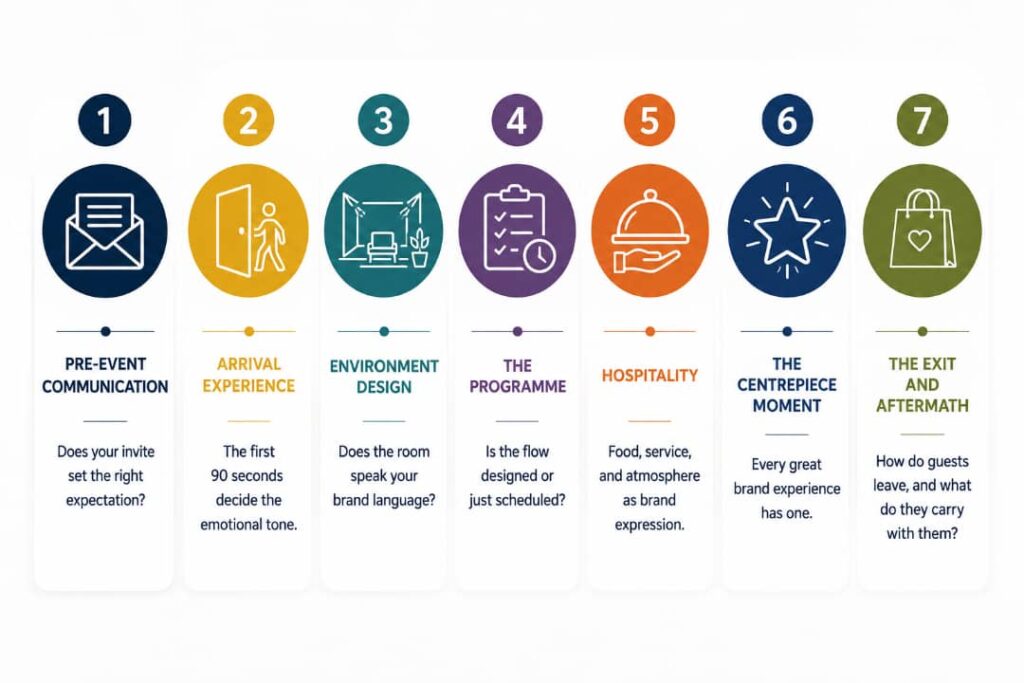
At Tantacom, we design around seven precise touchpoints to ensure brand continuity from start to finish. Here is where most corporate events drop the ball, and how to fix them.
1. Pre-Event Communication: Does Your Invite Set the Right Expectation?
Most organizations treat invitations and pre-event emails as simple administrative tools to push data, dates, and venue addresses.
The miss here is ignoring the psychological runway. The invitation is the literal first impression of your experience. If your brand positions itself as premium and forward-thinking, but your pre-event communication feels generic, cluttered, or operationally confusing, you have compromised the experience before the guest even RSVPs. Every email, digital interface, and confirmation note must match your brand visual identity and tone of voice.
2. Arrival Experience: The First 90 Seconds Decide the Emotional Tone
The moment a guest steps out of their vehicle and into your venue perimeter, a clock starts.
This is the registration axis, and it is the single biggest point of friction in traditional event planning. Long queues, chaotic accreditation portals, and confused check-in staff create immediate cognitive fatigue. The first 90 seconds dictate how relaxed, receptive, and engaged a guest will be for the rest of the day. A seamless, high-fidelity registration flow signals operational authority and puts the guest in the right state of mind.
3. Environment Design: Does the Room Speak Your Brand Language?
Walk into the average corporate event, and you will likely see a standard stage, standard lighting, and a few arbitrary roll-up banners.
This is where visual continuity breaks down. The physical space must act as an uncompromised, three-dimensional extension of your brand identity. The choice of typography, the weight of the structural design, the zoning of the room, and even the temperature of the lighting must align with the brand’s core aesthetic DNA. A well-constructed space commands attention and communicates authority without needing to shout.
4. The Programme: Is the Flow Designed or Just Scheduled?
There is a fundamental difference between a schedule and a design. Most corporate agendas are built around time blocks—packing panel after panel into a rigid timeline without considering human attention spans or energy levels.
When a programme is merely scheduled, guests experience information overload and mental fatigue. A designed programme treats time as a narrative arc. It carefully manages transitions, creates intentional space for networking, and balances high-intensity presentations with moments of reflection, making the complexity behind the curtain completely invisible to the audience.
5. Hospitality: Food, Service, and Atmosphere as Brand Expression
Hospitality is frequently outsourced and forgotten, measured simply by whether the catering is warm and served on time.
In a 360 brand experience, hospitality is treated as a core brand expression. The demeanor of the onsite team, the curated ambient soundscapes, and the style of service are all touchpoints. If your organization prides itself on seamless, modern execution, the hospitality cannot feel transactional or sluggish. Every interaction with a team member should reinforce the brand values of precision and care.
6. The Centrepiece Moment: Every Great Brand Experience Has One
Most events are flat. They move from one agenda item to the next at the exact same emotional and visual wavelength, resulting in a generic and forgettable experience.
Every great brand experience requires a structured climax—a definitive centrepiece moment that acts as the anchor of the day. This could be a dramatic product reveal, a visually arresting keynote presentation, or a highly curated, immersive segment that captures the absolute core message of the event. It is the specific, high-fidelity moment designed to be remembered and talked about.
7. The Exit and Aftermath: What Do Guests Carry With Them?
The final miss happens when the closing remarks end. Most companies consider the job done, leaving guests to navigate a chaotic exit, walk out into an unbranded corridor, and receive no meaningful follow-up.
The experience ends long after guests go home. The physical exit should feel as orderly and calculated as the arrival axis. Furthermore, the digital aftermath—the follow-up materials, the post-event resources, and the ongoing engagement—must maintain the exact same premium standards. How guests leave, and what they carry with them mentally and physically, cements the final ROI of the event.
From Checklist to Continuity
Most events nail two or three of these touchpoints. They might have great catering or a beautiful stage, but they fail on the registration flow or the pre-event build-up. The experiences that people truly remember, the ones that actively build brand equity and protect corporate reputation, get all seven right.
When you bring structure to physical spaces and treat every single touchpoint with intentionality, your event stops being an operational expense and becomes a powerful strategic asset.
Experience Architecture
Tantacom Group designs and executes integrated turnkey systems that ensure your brand strategy remains unbroken across all seven touchpoints. Explore our approach to Experience Engineering or consult with our team on your next high-stakes corporate platform at tantacom.org.